Sailing to Success Through Innovation with Bob Roitblat
This week’s Misfit Entrepreneur is Bob Roitblat. Over 3 decades, Bob has innovated, developed, and successfully exited over a dozen businesses. He has developed a unique way of leading and building a business in that he is a competitive sailor and has used the principles needed to succeed on the water to help his businesses and those he consults with to succeed at the highest levels.
The thing that struck me the most about Bob was his thought process around innovation and the tried and true systems he has created to help companies not only be able to innovate and create opportunities at high levels, but to continue to sustain that innovation over the long term.
Innovating is more critical than it ever has been in business. You can come out with a solution today only to see if become obsolete a short time later. Your ability to innovate as business owner, leader, or even just as an individual in your everyday life is a critical skill you must embrace. And in this episode, my goal is to give you a great set of principles to do that from.

When Bob was a kid, he wanted to be a star and he has actually been on more than 60 tv shows, feature films, and movies – it has been a hobby of his for many years. He also has sailed everywhere from California to Hawaii, the Caribbean, and the oceans in-between. As Bob notes, sailing is a wonderful metaphor for business because of the processes, systems, and strategies you need to follow the not only survive, but make a successful sailing trip with a crew.
Why does competitive sailing translate so well to running a business?
When you are sailing, you know what time the race starts and you know where the finish line is, but there is no playing field. How you get to the finish is up to you.
The race finishes when the first boat crosses the finish line – there are no quarters or periods of time.
The winds change without warning just like the environment in business can change without warning and you have to be able to respond.
You leave the dock with the people on your time, just like you run your business with the employees that you have and they may not all be the perfect ones that you wish you had. You run your business with who you have today.
The rules can change in that people in sailing can follow and take advantage of other boats and the ruling committee has to sort it out, just like someone in business can copy your product or service and a judge has to sort it out.
There are so many parallels.
What is the one thing you have taken from sailing and used in your businesses that you would say has contributed the most to your success?
Weather forecasting – In business, we do a lot of market and customer research. If we are narrow minded, we blindly follow the research.
But, market and customer research is a lot like weather forecasts – they are predictions, not contracts.
Just because the weather is supposed to be something today doesn’t mean that it will, just like your market research.
That is why test markets are so important to see if what the market research “the weather” is saying, is actually correct.
At the 9-min mark, Bob discusses how entrepreneurs can prepare themselves for the storms that come up in business
Look for leading and lagging indicators in your industry
If something is happening in one area of the industry, how does that impact you? What changes do you need to make to get ahead of things?
To find your leading/lagging indicators, look at the big impacting factors of your industry
Are they technological?
How does the economy impact you?
There are 3 kinds of business owners: Reactors, Managers, and Leaders
Reactors deal with what happened yesterday
Managers are dealing with what’s happening right now
Leaders anticipate what’s going to happen tomorrow
We must become leaders and anticipate so we can respond and not just react
Why do some organizations always seem to be on the cusp or innovation, while others stay stagnant?
Most organization start innovation by asking for ideas – this is backwards
You should start with by gaining insight first
They make sure they really understand the customer’s pains and frustrations first
They ask what your company’s needs are
Once you know you company’s needs and the pain/frustrations of the customer, then you can move to deliver a solution that solves both
What steps are needed to have a good innovation process?
Gain insight before asking for ideas
Asking for ideas focused on the two targets (fixing he customer pain and the major need of your company)
Implement an idea boosting culture – leadership must be willing to listen
Be open to ideas from all sources – be open to borrowing ideas from other industries and bend them to your needs
Bob gives a great example of how Ford really came up with the assembly line
Getting buy in from the constituents and stakeholders – you need everyone on board to implement an idea
Validate and Iterate – focus on an MVP (minimum viable product) and roll it out to a test market. Go through several iterations to get your solid product, then roll out.
Which step is most important? Why?
Insight before ideas. If you don’t have insight into the problem you are really solving, then your idea is much more likely to fail.
“People don’t buy products. They buy results. They buy progress. If your product can deliver the results and progress that people crave, it’s a winner.”
Characteristic of Great Innovators?
Unending curiosity – Be curious like you were when you were a kid when it comes to business
How does being a contrarian fit in to innovating and success?
Things are different in that there are tons of micro-markets now
When everyone is going one way in the “red ocean,” you can be a big player in a small market and create a blue ocean.
Look for the contrarian play as they exist in almost every industry in today’s world.
At the 34-min mark, Bob talks about what he has learned about creating a business to sell and selling a business
How can businesses best boost their profits?
Biggest challenge for a business is understanding “cost to serve”
140/20 rule. 140% of your profits comes from 20% of your customers
60% of customers are breakeven
20% of your customers are so unprofitable, they cost you money every time you do business with them.
If you can keep track of everything it takes to deliver a service to a client and allocate it to the specific client, you will find that a portion of your clients (20%) cost you money and bring your profitability down.
Your best course of action is to stop doing business with these customer
What is the most important area for business owners to focus on in their business?
Spend more time educating employees and expanding their ability to think and innovate
Tweet This: “The Customer is always right. Just sometimes they are right for someone else.”
Serial entrepreneur, Ironman qualifier, and host of 460+ conversations with the world's top founders. Pulling out the real story every week.
About Dave →
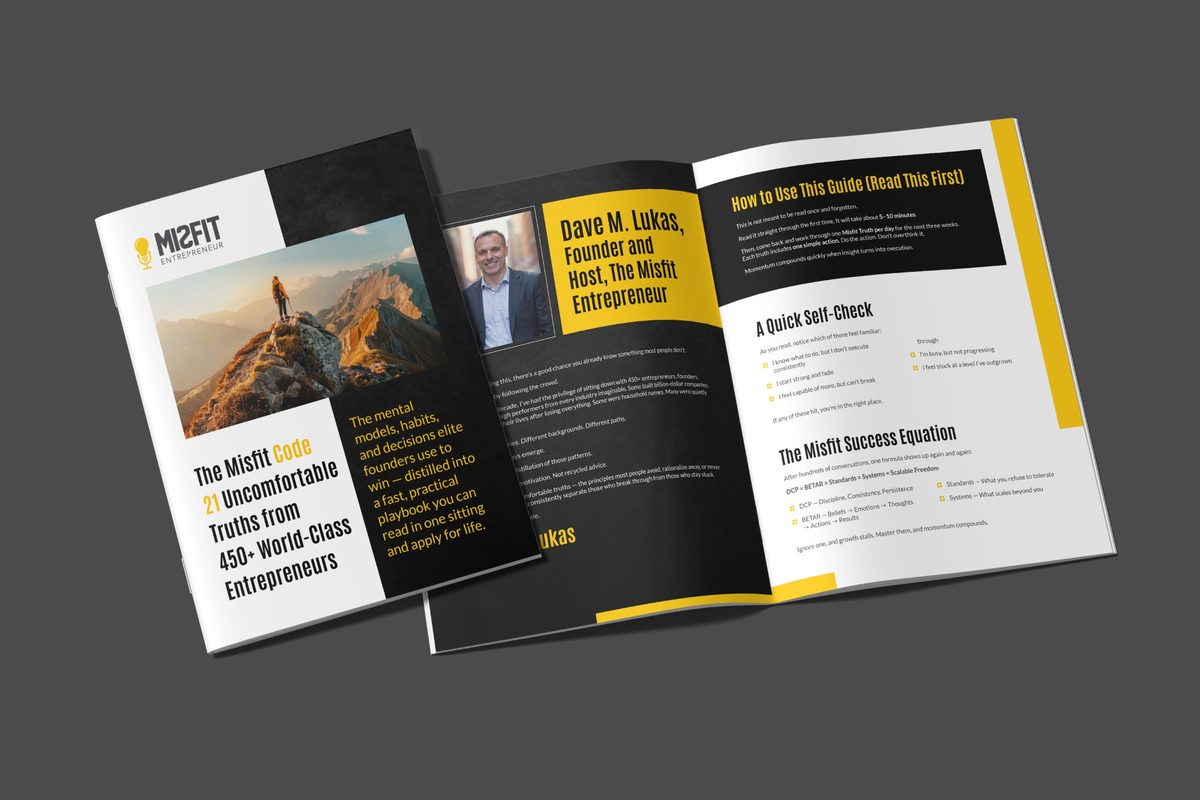
21 Uncomfortable Truths from 450+ World-Class Entrepreneurs. The mental models, habits, and decisions elite founders use to win — read in one sitting, apply for life.
Get Your Free Copy →
How high performers turn clarity into relentless execution. Build your Misfit OS™, install the weekly planning system, and close the gap between intention and results.
Get The Playbook →