412: Mastering Operations: Jhana Li's Proven Methods to Scale and Optimize Your Business
This week’s Misfit Entrepreneur is Jhana Li. Jhana is the founder of Spyglass Ops, a firm with a special focus on operations to scale small and mid-sized businesses. Jhana ran her first company while living out of a van traveling through North and South America. She has consulted with over forty 7 and 8 figure businesses and has coached over 500 founders on how to scale their operations and grow.
One of the biggest hurdles in building a great business is going through the challenge of building scalable operating systems and processes. But, if you can get this right, your business can grow exponentially. An I could think of no better expert to give us the playbook to do so than Jhana.
Jhana shares that before discovering her passion for operations, she felt directionless, living out of a van while traveling across North and South America. She was working a series of remote jobs, unsure of her career path but determined to create a life by her own design. It was during this time that she stepped in to help her then-boyfriend's digital marketing agency on a temporary basis, which unexpectedly led to her becoming the COO. Jhana admits she had no idea what operations entailed at the time, but she instinctively began solving problems within the company. This experience opened her eyes to the field of operations, and she eventually realized that her intuitive problem-solving skills were a valuable asset. This revelation set her on a path to coaching hundreds of founders, where she gathered extensive data on common business challenges and best practices. Using this knowledge, Jhana developed her own operations methodology, which she now uses to help her clients scale their businesses effectively.
What's the number one thing entrepreneurs get wrong when trying to scale their operations?
There is a misconception that operations are just about SOPs, systems, tools, and meetings.
Operations really provides a unique lens that complements the visionary’s role. It is the area that most helps the business reaches it’s true potential.
Example: auditing billing systems and discovering significant financial leaks unnoticed by the CEO.
All businesses need to have a focus on hiring a great operator and empower them to identify and fix inefficiencies.
Where's the first place you start with a new client and why?
Jhana starts with a comprehensive company-wide audit.
She does team interviews and system reviews to identify operational bottlenecks.
She them produces a detailed report highlighting issues and a 12-month roadmap to achieve client goals.
She customizes the approach based on each founder's unique goals and business needs.
What are the key elements of a scalable business system, and how can small businesses implement them effectively?
Jhana has zix core pillars: Strategy, Leadership, Team, Systems, Communication, and Data.
Strategy: Ensuring the founder carves out time for strategic thinking and communicating the vision to the team.
Team: One-on-one meetings to align individual roles with the company’s strategic vision.
Leadership: Careful internal promotions, ensuring leaders are better at managing people than performing tasks.
Communication: Automating communication to reduce costly manual interactions.
Systems: Implementing project management tools to streamline operations.
Data: Focusing on data collection and analysis as the business scales to maintain visibility and make informed decisions.
Can you give one action item for each of the six pillars?
Strategy: Regular strategic planning sessions.
Team: Aligning individual roles with the strategic vision through one-on-one meetings.
Leadership: Avoid promoting top performers unless they excel in management.
Communication: Automate routine communications to save time.
Systems: Use project management tools like ClickUp, Asana, or Monday.com.
Data: Integrate data analysis as the business grows to maintain oversight.
Can you give an example of a small business that successfully scaled using your methods?
Jhana talks about an entrepreneur client who was doing everything in his business.
She helped them create a systematic delegation of tasks to a capable team.
After helping to delegate, the entrepreneur could then focus on visionary tasks and future planning, achieving personal freedom and business growth.
What role does technology play in building scalable systems, and what are some essential tools?
We should see technology as the skeleton of a business, especially for operational needs.
Essential tools: Sales CRM (e.g., Salesforce, HubSpot, Go High Level) and a project management system.
Tools help coordinate and streamline business operations, making them more efficient.
Have you experimented with AI tools like ChatGPT for creating processes?
Yes, but specialized tools like ScribeHow for SOPs can be more effective.
Jhana recommends using AI tools tailored to specific operational needs for maximum efficiency.
What are the biggest lessons you've learned as an entrepreneur?
Business growth is tied to personal growth; constant personal development is crucial.
Business serves as a mirror, highlighting areas for personal improvement.
It's essential to understand and operate within one’s unique strengths and talents.
What do you wish you knew sooner as an entrepreneur?
Jhana shares that understanding her unique strengths was something she could have learned to focus on earlier.
The importance of doing less but excelling in what one is uniquely good at for scaling a business.
How do you figure out your zone of genius?
Continuous personal discovery and development.
Utilizing support networks like coaches, therapists, and relevant books.
Recommended reads: "10X Is Easier Than 2X" and "The Great Leap."
Anything around operations that we haven't covered yet that we should have?
Operations are not just about SOPs; they are crucial for growth, freedom, and impact.
Prioritize investing time, energy, and resources in operations for sustainable business success.
We are not the highest version of ourselves that we can imagine. We are the lowest version of ourselves that we can accept.
Serial entrepreneur, Ironman qualifier, and host of 460+ conversations with the world's top founders. Pulling out the real story every week.
About Dave →
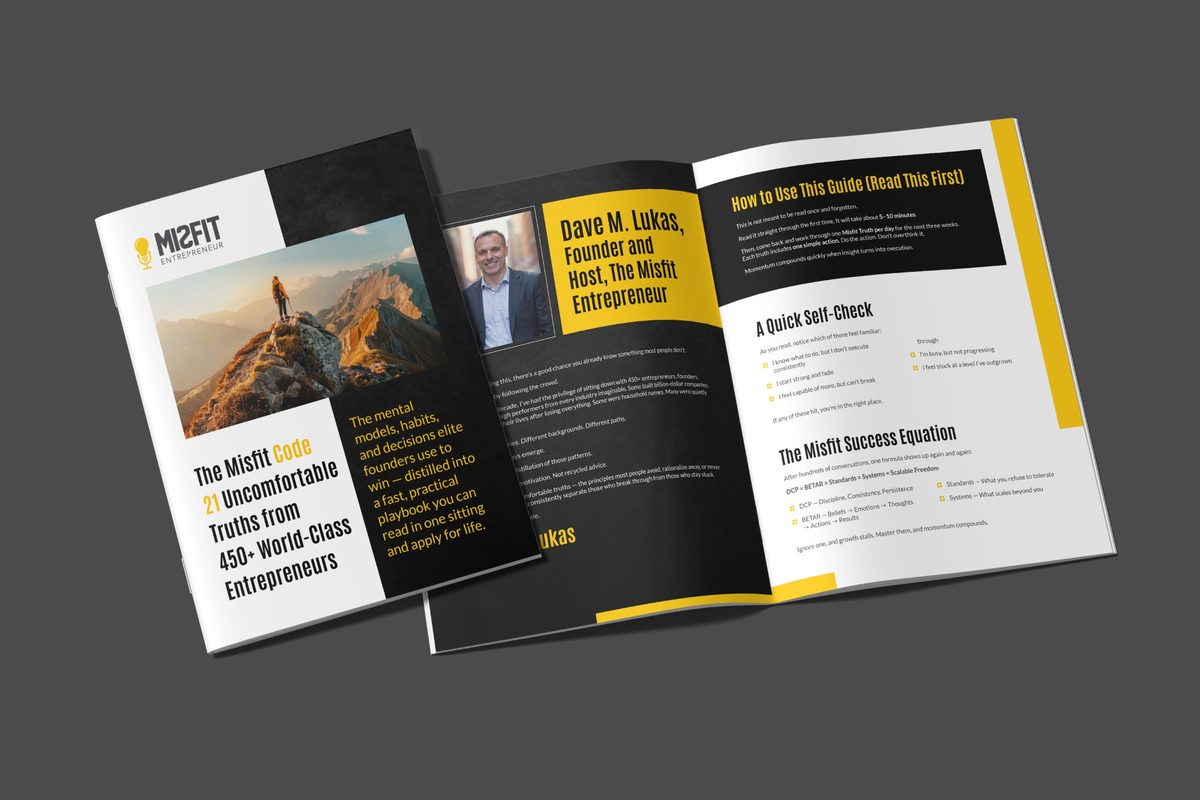
21 Uncomfortable Truths from 450+ World-Class Entrepreneurs. The mental models, habits, and decisions elite founders use to win — read in one sitting, apply for life.
Get Your Free Copy →
How high performers turn clarity into relentless execution. Build your Misfit OS™, install the weekly planning system, and close the gap between intention and results.
Get The Playbook →